
Recently, a new report from RAND Europe, The intersection of occupational safety and health with emerging technology, has provided a crucial update on the state of SafetyTech.
The report offers a comprehensive evidence review of this nascent field to date. By mapping what is and isn’t known about the impact of new technologies on worker well-being, the report has become a strategic blueprint for the next phase of research, cementing “safetytech” as a recognized discipline with a clear path forward.
I am proud to have had the opportunity to contribute to this report and honoured by the plentiful references to a recent report I co-authored, Delivering Safety Innovation.
More importantly though, it gave me a chance to reflect on how far we have come in this area, and consider the challenges that still lie ahead.
The Power of a Simple Question
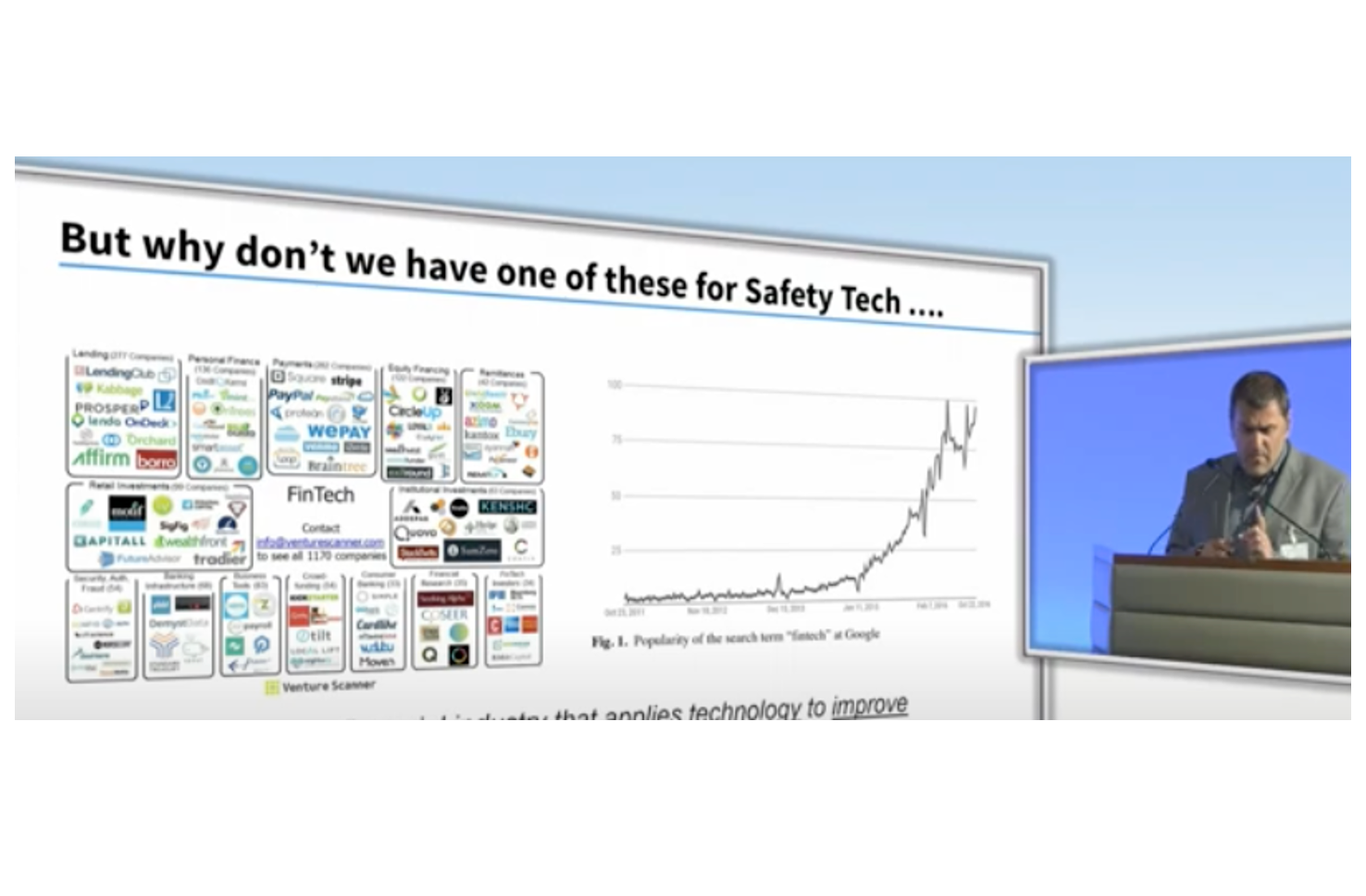
In 2018, I stood in front of a large audience at the Lloyd’s Register Foundation Conference to give a presentation on the latest technologies and especially AI addressing safety and risk in safety-critical industries. (watch it on YouTube)
The highlight of the presentation, however, was a simple provocation: “Why don’t we have safetytech?”
We had fintech, medtech, and “tech” for other fields, but the application of technology to occupational safety and health, or to address industrial risks for that matter, lacked a unified identity. It was a fragmented landscape of robotics, sensors, data analytics, and immersive training, etc. but without a collective definition, or an identity.
It was a call to frame a new approach to safety-critical innovations, one driven by entrepreneurship and innovation.
Today, that initial provocation has certainly done its job. I wasn’t the only one thinking along these lines, and since then, a lot has happened, both in practice and in advocacy.
Are we on a path to normalization?
It’s still early, but we can certainly say that the “safetytech movement” is now underway, with major international bodies actively shaping its future.
The ILO, for instance, has already unveiled its report, Revolutionizing health and safety: the role of AI and digitalization at work, (proudly also referencing work I have been involved in) demonstrating how OSH community is starting to embrace this field.
Simultaneously, the UNIDO’s Manifesto for Global Industrial Safety provides a blueprint for leveraging technology to make industrial work safer. It’s a clear statement that global bodies are not just observing this movement, but actively guiding it. The manifesto declares safe working conditions a fundamental human right and advocates for technology to be the central tool for achieving this goal.
This normalization is further validated by the new RAND Europe report. Its very purpose is to map the existing evidence base for safetytech, which is a significant step beyond simply acknowledging its existence.
Yet the report reveals a new and important truth: while safetytech is starting to become a recognized field, its evidence base is still patchy and uneven.
Rigorous research on safetytech is limited, with the strongest evidence supporting technologies like smartphone applications and AR/VR training. It also raises a crucial point: technology not designed for safety can still have a profound impact on it. The report warns of the psychosocial risks from technologies like algorithmic management and emotional AI.
The Next Chapter
The RAND report is the latest example providing a clear mandate to continued innovation and advocacy in safetytech. But with more recognition, comes greater responsibilities.
We must step up the rigorous evaluation of its impact, ensuring these advanced technologies, especially AI and genAI when used in safety-critical applications, are themselves safe and used responsibly
The next phase of this journey needs to boost trust, evidence, and scaling safely, including:
- Building the Evidence Base: We must address the gaps identified by RAND Europe and others with large-scale, real-world studies that prove what works.
- Integrating Worker Voices: As the ILO and UNIDO have emphasized, the human element cannot be forgotten. Workers must be at the center of technology design and implementation.
- Ensuring “Safe Tech”: We must actively manage the risks of new technology, especially AI, from privacy concerns to the potential for complacency. Safetytech must not only be “tech for safety and risk,” but also “safe tech” itself.
So the question mark is gone. Safetytech is here, normalized, recognized, and increasingly embedded in our global discourse.
The next chapter is to make it count even more.