
Recently, prompted partly by my book Industrial Safetytech and partly by small talk, clients, partners and old colleagues have asked me about safetytech, how it started, what it actually means, and where it is going.
So I decided to pull together an extract from the book that covers how things unfolded in the past few years, at least from my perspective, and add one aspect of it all that I find particularly fascinating. Read on!
Innovations without a shared identity
By the time the word “safetytech” and its equivalents began to circulate, the applications of emerging technologies to workplace safety, and industrial safety in particular had already been around for years. Sensors had monitored industrial environments for decades, drones were inspecting infrastructure, computer vision was appearing on construction sites and factory floors.
True, analysts had been mapping the traditional workhorse of the space, the EHS software market, since the early 2010s, but the rapidly growing use of emerging technologies did not have a clear home. The software platforms, the hardware, AI and operational technology companies developing these tools have been tracked by different analysts, discussed at different conferences and funded through separate channels.
And on the ground, an operations manager running a drone inspection programme and a safety manager deploying computer vision for PPE monitoring are doing closely related work, yet they have little in the way of a shared professional community, a common language, or a framework that ties what they do together in a way that investors, regulators and their own organisations can readily grasp.
Flagging a gap, and the necessity to give it a name
In 2018, at a Lloyd’s Register Foundation conference, while presenting some of the latest developments in AI and Industry 4.0 in safety-critical contexts, I asked the audience a simple question: why don’t we have safetytech?
We had names for FinTech, MedTech, PropTech and a growing list of others. In each case, giving a name to the application of technology within a traditional industry had attracted investment, talent and institutional attention, given it an identity, and created industrial clusters, government programmes and even an asset class. Should there be a name?
The question had a backstory. In the real-world innovations we were working on before the conference, we kept finding ourselves using long, varied sentences to explain what we were doing (try: “emerging technologies applied to industrial safety use cases”), and it became clear that perhaps we needed a shorthand that could do some of the heavy lifting for us.
Growing institutional attention
As it happens, other people and organisations around the world were looking at the same space and thinking along similar lines, albeit from different perspectives. Over the following years, a number of institutions began producing reports, launching programmes and building frameworks around the application of technology to industrial safety.
Here are what I think are the main examples, in no particular order:
- The National Safety Council in the USA (NSC) launched Work to Zero in 2019, mapping over 100 technologies against 18 high-risk workplace situations and replacing what it described as “shiny object syndrome” with a structured methodology
- Safety Accelerator, established in 2018 by the Lloyd’s Register Foundation (LRF), was arguably one of the first formal attempts to test whether safetytech could function as a coherent category through working with deep-tech companies and industrial players. (Disclaimer: I co-led its set up.)
- In 2020, the LRF published the first formal attempt to define and size the sector as a market.
- The UK’s Health and Safety Executive (HSE, the UK’s regulator) established two regulatory sandboxes specifically for industrial safety technologies.
- The UN’s International Labour Organization (ILO) also moved into this space with its 2025 publication of Revolutionizing health and safety: the role of AI and digitalization at work, advocating the use workplace technologies under a strict “human-in-command” framework.
- IOSH established practical frameworks for the digitalisation of occupational safety with their 2026 white paper, The Digital Dilemma: Balancing Progress with Worker Protection. Championing a “safety-by-design” approach to mitigate digital hazards, they have also endorsed a Safety 4.0 training programme.
- The United Nations Industrial Development Organization (UNIDO), alongside the LRF and the Cambridge’s Institute for Manufacturing, launched the Global Initiative for Industrial Safety (GIFIS), actively driving the adoption of safetytech, including AI, IoT, and robotics, to safeguard vulnerable industrial workforces in developing nations.
- EU-OSHA’s 2023-2025 “Safe and healthy work in the digital age” campaign highlighted both the opportunities and risks of digitalisation of OSH. It showcased how robotics and smart OSH systems remove workers from hazardous tasks, while offering guidance to tackle algorithmic pressures and psychosocial challenges.
- RAND Europe produced a scoping review of the global OSH landscape, mapping where empirical research is strong and exposing critical evidence gaps in the real-world evaluation of emerging safety technologies.
Some of these efforts emerged independently, others grew out of joint initiatives or built on each other’s work, and there is considerably more happening around the world than this list captures, including on the regulatory side.
In my mind, one thing seem clear: while it’s still early, this breadth and depth of institutional focus on the relationship between technology and industrial and workplace safety, and the attempts to bring various strands together, did not exist a decade ago.
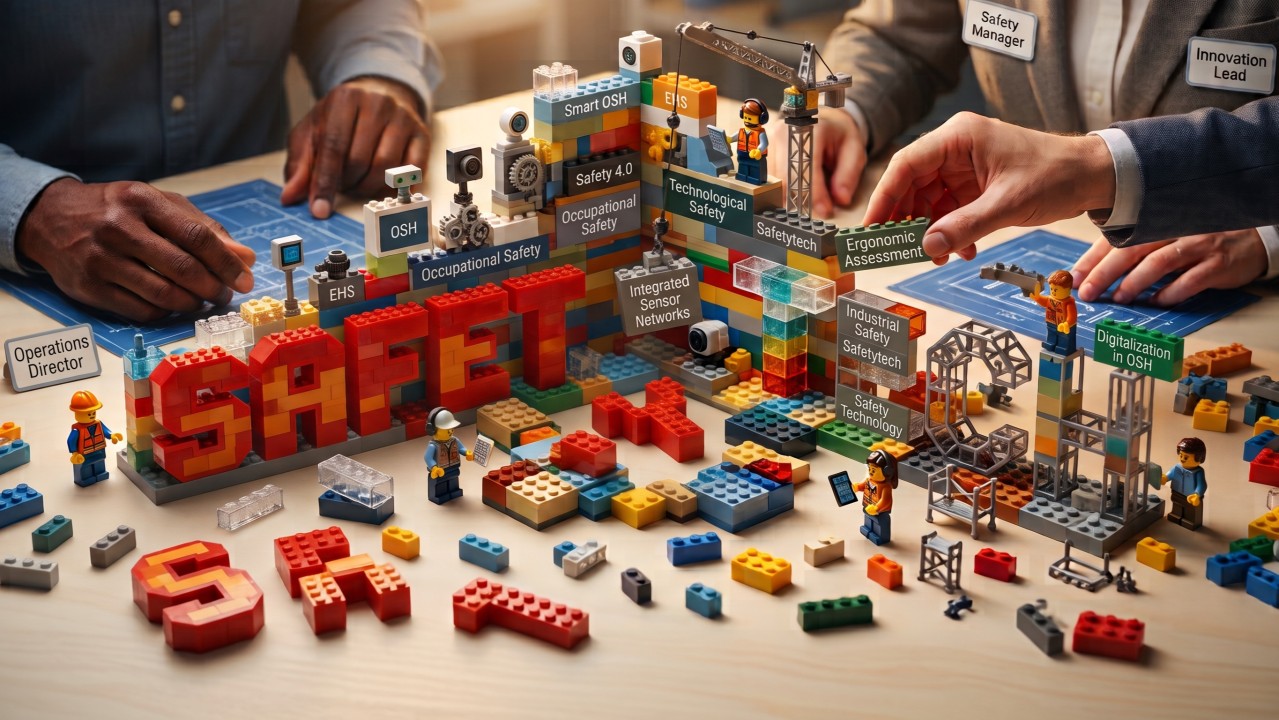
Still so many names!
What I find most interesting, though, is that nobody could (and still can’t) quite agree on what to call it.
Some have coined compound terms, some describe what the technology does, some anchor it in established professional vocabulary. The table below captures examples of some of the terms in circulation, in an entirely non-scientific way and in no particular order.

But does the name matter?
I think yes and no. At this stage, the more interesting question is whether there should or could ever be a single name in the first place.
Would it help? Probably yes. Consider how convenient it is to say “fintech” instead of juggling permutations of “technologies”, “banking”, “payments” and “financial infrastructure”. A good moniker compresses all of that into something a non-specialist can immediately grasp.
But several things work against a single term:
- The vast majority of these technologies are dual purpose, sold and bought for efficiency or digitisation of processes while also having a strong safety use case. Only a subset, such as EHS software, can be considered pure-play.
- The technology companies and their analysts use entirely different categories. If you sell computer vision for geofencing, you are an industrial AI company, not a safetytech company. The label always cuts across other categorisations.
- Most successful X-Tech monikers worked because X was either a massive sector (e.g. fintech, biotech, martech) or a narrow, well-defined technology field (e.g. nanotech, quantum-tech), providing a strong anchor. Industrial safety is a profession with institutions and certifications, so the anchor is there in principle, but the jury is still out on whether the pull is strong enough.
- There has not yet been an explosive, highly focused moment, such as a surge of investment or investor attention, that made any single term go viral and stick.
But I have come to think that a single name matters less than I originally assumed. In fact I think that it does not necessarily need one to progress, and it may even turn out to be counterproductive.
Those of us who have been around long enough would remember the naming and definition merry-go-rounds for things such IoT and Digital Twins and how there is still ambiguity about the definition and boundaries of EHS, OSH, H&S, workplace safety.
Is it becoming a distinct discipline?
Spoiler: I think not yet.
What seems to be the case is that the “field” (the naming problem again!) has certainly become more visible, current and coherent.
Client interest and demand is high, entrepreneurial activity is strong, investments made (some large), products bought and sold, conferences regularly talk about emerging tech and AI in EHS, OSH and workplace safety. And when institutions are producing major reports, programmes, and frameworks around the same subject, it may be approaching a tipping point, whether or not it has settled on a single name.
An interesting question is whether the work being done under all of these different labels is drawing together into something that starts to resemble a coherent field, a discipline. As I discuss briefly in the book, a discipline needs a body of knowledge that does not fully belong to any adjacent field, a professional community with shared standards and training pathways, and its own institutional infrastructure.
But in my view it is not yet a discipline. It has some of these things emerging, but not all. It has a growing community and some institutional attention, but its core knowledge is still largely synthesised from safety science, engineering, computer science and management.
Whether it matures further, and how, will depend on whether it develops a deeper and more independent evidence base, dedicated training pathways, and methodological foundations of its own, perhaps even a technology asset class, and why not, more consensus on the name!
Let us watch this space!
Let us continue the conversation?
I talk more about this, as well as industrial innovation and AI, in my book and various articles and blogs. If you are working in this space and/or want to compare notes feel free to reach out for a virtual coffee!
Links:
- 📚 Book on Amazon: https://www.amazon.co.uk/dp/B0H1XYFWYW
- 🌐 More insights at Enexem Consulting: www.enexem.com