
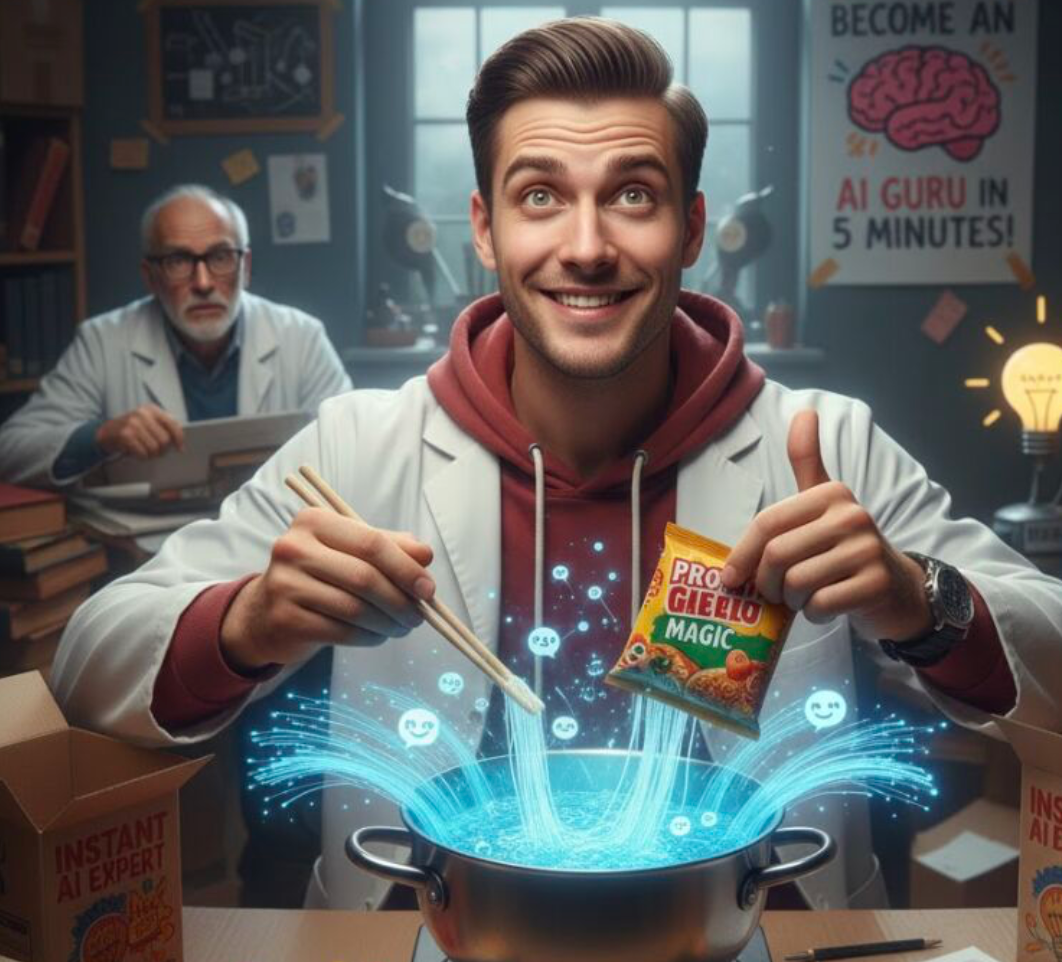
Was 2025 the year of the “Instant” AI Expert?
It has been fascinating to watch 2025 become the year where it seems everyone is suddenly an AI expert, when probably >99% of all we are doing with AI is prompting. It’s a bit like claiming to be an internet expert because one knows how to use Google search, a phenomenon actually seen during the dot-com hype.
For those of us in this field for decades, it’s a strange time. I’m happy to see the field I bet my career on becoming “hot,” and so so powerful, but I am also a little worried if the focus shifts away from treating it as fundamentally advanced, hard tech, built on decades of painstaking R&D.
One of my best ever bosses once told me “in the land of the blinds the one-eyed man is a king,” and it feels that’s what we are going through right now: everything is so new!
Yet, IMO real AI expertise is much more nuanced, rooted in the rigorous application of statistical models, meticulous data preparation, testing, careful ethical considerations, deployment architectures and more.
So perhaps this is why my favourite predictions for 2026 all fall into one camp: WILL THIS BE THE YEAR OF REALITY CHECKS?
- The field will start to stratify into the vast majority of (just) AI users and the expert few who possess foundational AI expertise to build stuff with AI, mirroring the specialization that followed the dot-com boom.
- Corporates and governments will start being far more selective about who they hire and trust, signaling the rise of truly authenticated specialists.
- After the initial rush, governments will slow down their AI purchases, focusing on actual value delivery and how AI can improve public services and operations.
- The rise of the “boring AI,” the one that quietly solves practical efficiency problems without much fanfare (e.g., better supply chain management, automating financial reconciliation, modernising legacy software).
- Ethical and regulatory backlash will intensify. Initial neglect of security, bias, and responsible use will be replaced by as rush of governance improvements and use of Responsible AI frameworks.
I have other favourites, such as AI business models being sorely tested, how excessive vendor financing will put even more strain on valuations, the emergence of small/narrow models and efficient inference engines, chain-of-thought processing taking centre stage, and embodied AI as the new, nearly infinite source of new training date.
But that’s probably all for now, other than wishing a HNY!